
Guilford County City Directory Collections
Greensboro supplies the broadest Guilford County city directory run. Its holdings begin with 1879/80 and extend through 1982, with gaps. The research trail has two parts: scans that can be read online and later, suburban, or alternate copies that still require a visit to Greensboro Public Library or the Greensboro History Museum Archives. High Point is a separate collection, not a Greensboro appendix. Its first directory is from 1908, and printed directories continue from 1910 to the present at the High Point Heritage Research Center.
| Collection | Years or contents | Where held | Access |
|---|---|---|---|
| Greensboro directories | 1879/80-1982, with gaps | GPL Central, GHM Archives, UNCG projects | Scans and in-person copies |
| Digitized Greensboro run | 1884-1963 | Digital Greensboro / Triad collection | Browse images and PDFs |
| Later Greensboro scans | 1964-1982 | UNC-Chapel Hill originals, online collection | Digitized scans |
| High Point directories | First 1908; printed 1910-present | High Point Heritage Research Center | Some online, printed runs on request |
| 1887 African-American directory | Names, occupations, and addresses | Greensboro Public Library | Public PDF with abbreviation key |
The coverage table is a routing tool, not a promise that every year is complete. Preserve the publisher and title page found in the volume. The Greensboro holdings do not support calling every book a single publisher, and a missing year can reflect a gap in survival, digitization, or library holdings.
Guilford County City Directory Scans
Digital Greensboro's Triad directory collection provides a practical starting point for the scanned Greensboro volumes. The collection includes the 1884-1963 digitization work from copies held by UNCG, GPL, and GHM, plus scans of the 1964-1982 run from UNC-Chapel Hill originals. Read the volume title page before recording a citation because publishers and edition labels change across the long run.
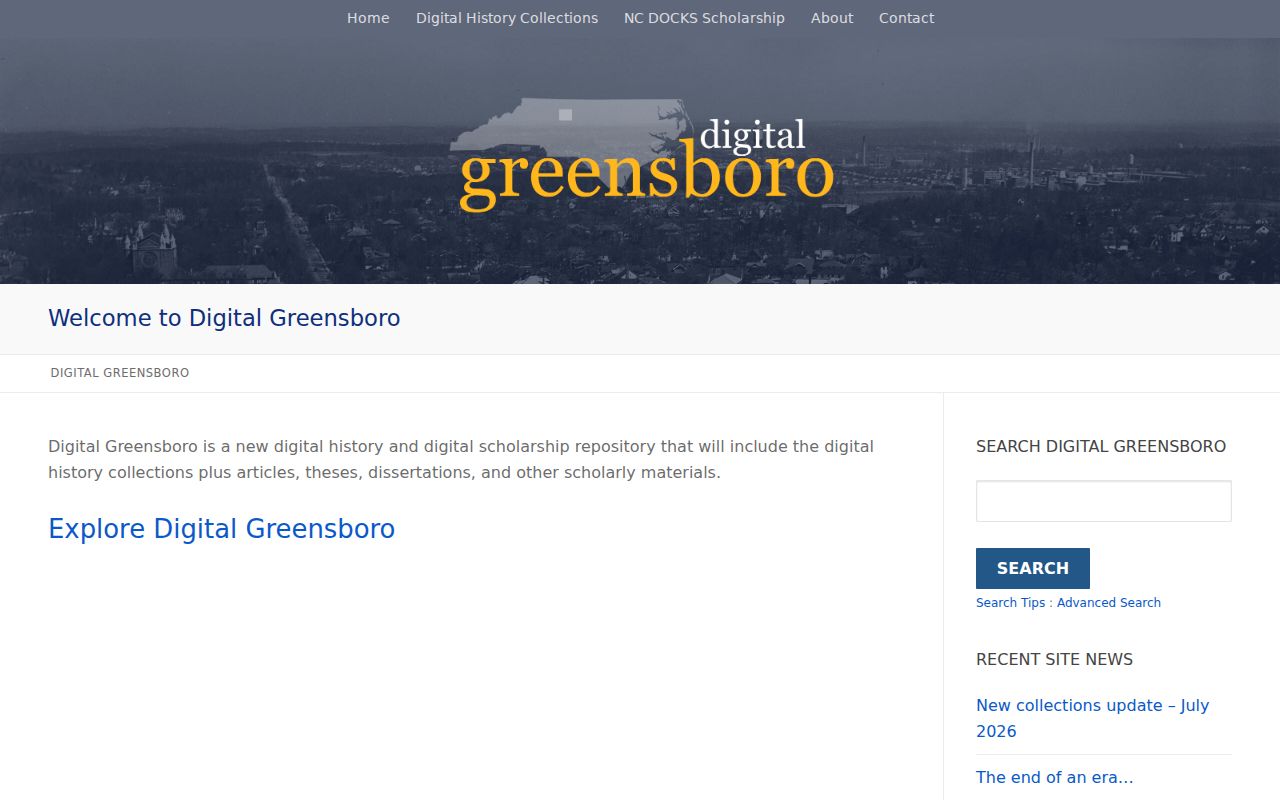
The collection screen helps a researcher move from a name to the actual year rather than relying on a search-result snippet. It also makes gaps visible, which matters when comparing an address across decades.
The known digitized list includes 1879/80, 1884, 1887, many annual and paired editions through 1963, then 1964-65 through 1981-82. That is strong coverage, but it is not a single uninterrupted run. GPL Central also has microform under call number 317.56 G81, a useful fallback for copies that are not easy to locate online.
Reading Guilford County City Directory Entries
A city directory entry must be read literally. The 1887 African-American Greensboro volume offers a clear local example: Adams, Ernest, porter, h Davie. It supplies a name, occupation, and a residence notation. Here, h means house. It does not establish a spouse, date of birth, or a continuing residence.
| Alphabetical entry | Name first, followed by the facts the editor chose to print. |
|---|---|
| Occupation | A listed role at publication time, useful for comparing people with the same name. |
| Address notation | h means house; r means rooms; the street may be abbreviated. |
| Abbreviation key | bds means boards, wid widow, cor corner, opp opposite, and nr near. |
| Reverse section | An address-to-occupant section, often called a criss-cross directory. |
- Criss-cross directory
- A reverse section arranged by street address rather than person name.
- Householder index
- A list built around the person or household identified at an address in that edition.
- Abbreviation key
- The volume's own glossary. Its meanings can change between editions, so use that book's front matter.
Spelling was not uniform. The library notes italic candidates for 1880 census comparison and bold names that usually identify business owners or professionals. Search initials, alternate spellings, and nearby streets. Older volumes may also use segregated sections and historical labels that should be preserved and understood in their period context.
Guilford County City Directory Desks
Local access matters when a scan ends or a street name needs context. Greensboro Public Library's genealogy and local-history collection has printed and microfilm directories, family histories, newspapers, yearbooks, cemetery and obituary indexes, librarians, and licensed databases. Central Library lists genealogy hours as Monday through Thursday 9-9, Friday and Saturday 9-6, and Sunday 2-6. Ask for the genealogy desk, the directory shelf, or a microfilm reader, and call ahead for holiday or collection changes.
Greensboro Public Library
Genealogy and local-history collection, directories, newspaper files, cemetery indexes, and microfilm.
Greensboro History Museum
Archives at 130 Summit Ave.; directories, maps, Sanborn material, newspapers, and city records. Tue-Sat 10-5, Sun 2-5, closed Mon; 336-373-2043.
GHM recommends appointments. Its printed-materials holdings identify the directory years and alternate Internet Archive links. The library and archive are especially useful for turning a name hit into a family-history question, without treating one printed entry as identity proof.
GPL's collection reaches beyond the directory shelf. It includes how-to books, family histories, published genealogies, Guilford County Genealogical Society pedigree charts, North Carolina biography files, and newspaper clippings. The local-history staff can point a searcher to a licensed database or a microfilm reel, but collection rules and availability can change. High Point's research center supplies a second access route for telephone directories and local newspaper microfilm when the question belongs to that city rather than Greensboro.
Use the collection that holds the source, then preserve its edition, page, and exact spelling. A library directory, a museum scan, and a newspaper notice are complementary records. They should not be blended into a single undated profile.
Guilford City Directory Runs in High Point
High Point's heritage and people-research resources add the county's second major city record trail. The High Point Heritage Research Center is at 901 N. Main St. and holds city directories, local telephone directories, the High Point Enterprise, the Greensboro Patriot, and family materials. Its first city directory is 1908, with printed directories from 1910 to the present and some online access.
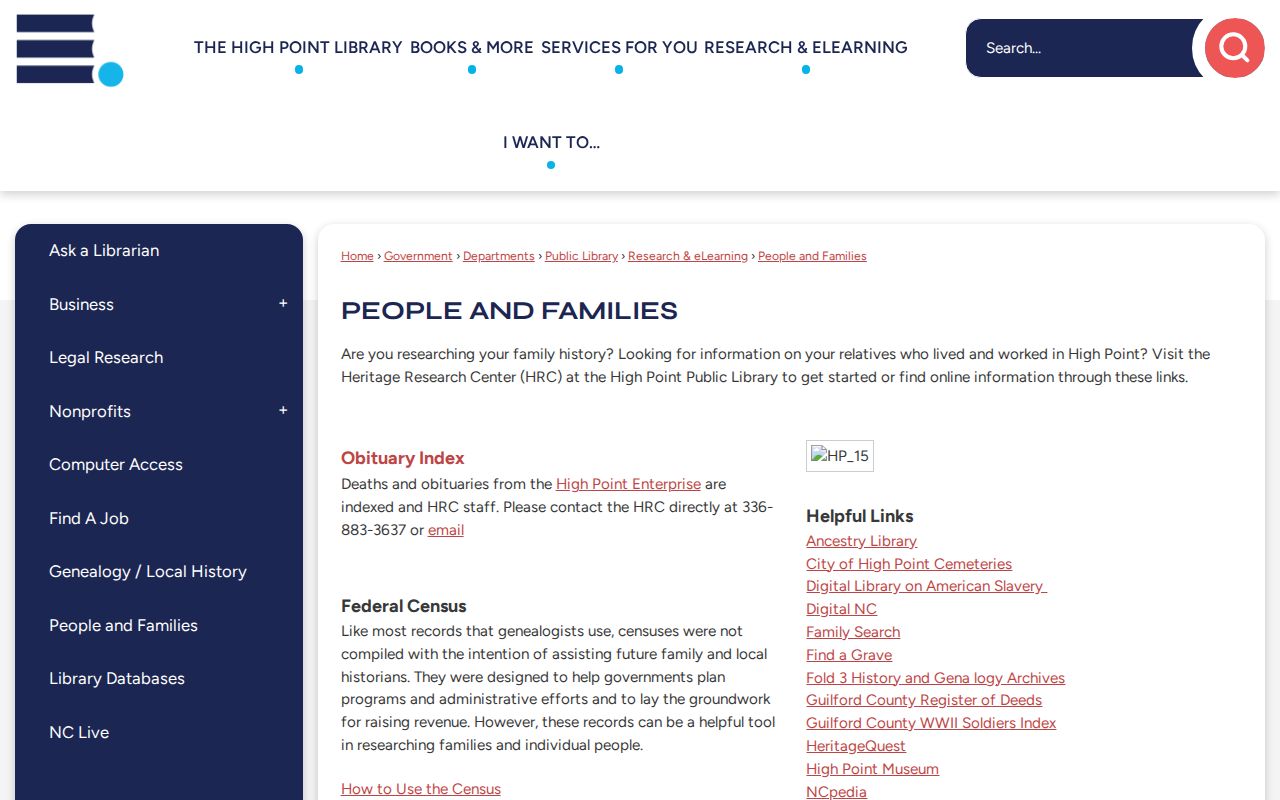
The High Point collection prevents a common countywide mistake: a Greensboro directory absence does not decide whether a person appears in High Point sources. The center lists hours of Monday and Friday 9-6, Tuesday through Thursday 9-8, and Saturday 9-1 and 2-6. Its phone number is 336-883-3637.
Tracing Guilford County City Directory Families
Start with a known year and transcribe the entry, including its street spelling and abbreviations. Then compare the next nearby edition, not a volume decades away. Pair the directory with the federal census that best brackets it: 1887 with 1880, 1907-08 with 1910, and 1939-40 with 1940. Federal census releases follow a 72-year rule, so 1940 and earlier were public by 2026, while 1960 is not yet public under that timetable.
- Record the name, occupation, street notation, and every abbreviation exactly as printed.
- Check an earlier and later Guilford County city directory for a move, an initial change, or a street variation.
- Compare the best nearby census year, then test the household with an obituary, burial, deed, or marriage record.
- Use the reverse section when the address is known, and write down the edition date before drawing a conclusion.
For a former classmate or family trail, the library's directories, yearbooks, obituary resources, and cemetery index offer complementary evidence. GPL's Burial Index covers more than 35,000 burials at Forest Lawn, Green Hill, and Maplewood. A modern name check belongs in the Guilford County resident lookup, where current official records can be compared with the dated historical result.
Guilford's 1887 African-American Directory
The 1887 Greensboro directory is a distinct historical resident source, not an optional footnote. GPL describes it as a complete list of African-American Greensboro residents and records names, occupations, addresses, and an abbreviation key. Its tobacco-era occupations and neighborhood references can help identify a person in a period where other sources are thin. They also reflect segregation-era editorial structure and period spellings, which should be handled with care rather than modernized away.
Maplewood was established in 1918 for African-American burials after Union Cemetery closed. The 1887 directory, Maplewood and Union Cemetery material, partial 1880 African-American census records, and GHM collections form a local trail with its own evidence limits. The county's Slave Deeds project documents an earlier system of enslavement, not a modern resident list.
Guilford County Directory Gaps
Record loss changes what a directory can answer. British forces burned much Guilford material from about 1771 to 1781. GPL's Colonial Court of Pleas and Quarter Sessions transcriptions cover 1781-1811 in three volumes and more than 900 pages, but they cannot replace destroyed originals. The 1890 federal census was destroyed in a 1921 fire. Compare 1880 and 1900 census records with local directories, deeds, tax maps, church or cemetery records, and newspapers instead of treating the missing census as a dead end.
Guilford's recorded land history begins May 4, 1771. The Register of Deeds says its index and images reach from the original 1771 records forward, but older access can still be a physical or microfilm question. GPL lists Record of Deed microfilm for 1771-1922, the white marriage register for 1867-1970, and a birth index for 1913-1981. Those records can establish dates and relationships around a directory entry without pretending they fill every lost or unscanned year.
Note: A directory omission may reflect an unprinted year, a changed name, a move, a limited listing rule, or a surviving-copy gap, not proof that the person was absent.
When a Guilford City Directory Is Silent
A blank search can be useful if it is described honestly. Check the city, edition year, spelling, initial, occupation, and old street name. Then use the physical collection, newspaper files, a cemetery or obituary index, and deeds or court material as the question requires. The city directory is one dated source among several. It should narrow a historical trail, never settle an identity question by itself.